
Water treatment guide
How Does UV-C Water Purification Work?
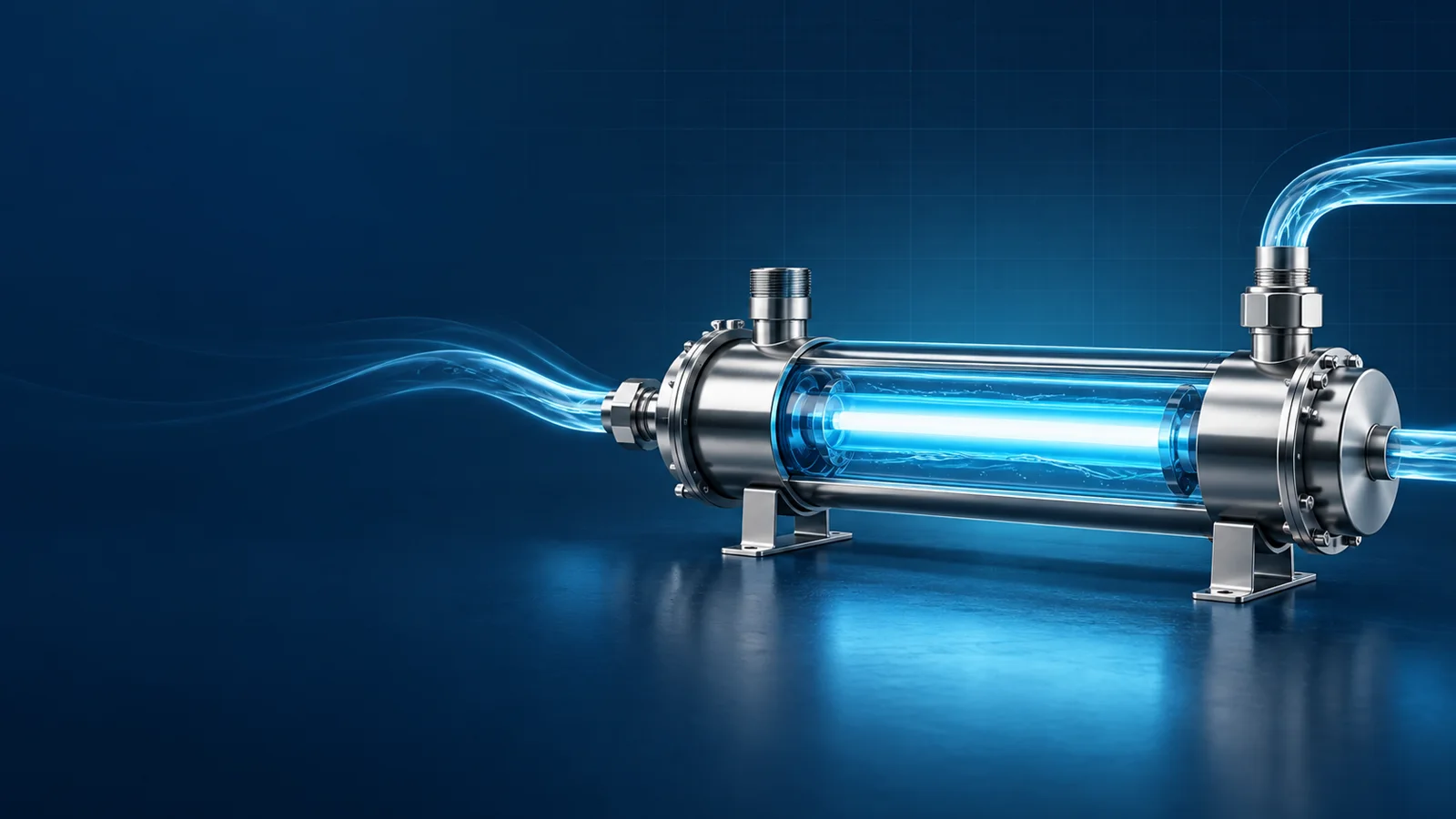
UV-C water treatment disinfects clear, pre-filtered water by delivering ultraviolet energy as water passes the lamp chamber. A correctly specified system can reduce bacteria, viruses and parasites, but performance depends on UV dose, flow, water clarity, lamp condition and maintenance. UV does not remove sediment, salts, hardness or dissolved chemicals.
What UV-C changes—and what it leaves behind
UV is a disinfection stage. Water flows through a chamber around a UV lamp, and the delivered light energy inactivates susceptible microorganisms so they cannot reproduce. Unlike a sediment or carbon filter, the chamber does not collect particles or adsorb dissolved compounds. The CDC recommends pre-filtration because UV performs better when particles have already been removed.
| Question | Practical answer |
|---|---|
| Primary job | Disinfect water by reducing susceptible microorganisms. |
| Does not remove | Sand, rust, hardness minerals, salts, metals or most dissolved chemicals. |
| Critical variables | Validated UV dose, peak flow, UV transmittance, turbidity, lamp output and sleeve cleanliness. |
| Best position | After the required sediment, carbon or specialist treatment stages and as close as practical to final distribution. |
The exact order and equipment depend on the laboratory results, plumbing and required flow; this sequence is a planning example, not a universal specification.
Why flow, clarity and dose matter
UV performance is not determined by lamp wattage alone. A unit should be sized for the property’s peak flow and the manufacturer’s validated dose. If flow exceeds the rated value, exposure can fall. Cloudiness, iron, manganese, scale or a dirty quartz sleeve can also reduce the UV energy reaching microorganisms. The US EPA UV guidance describes dose as a function of intensity and exposure and explains how water quality can affect UV transmittance.
UV also leaves no disinfectant residual in downstream pipework. That makes hygienic installation, protected storage and clean distribution plumbing important. A UV unit should not be used to promise that untreated or chemically contaminated water is safe.
Local context
A Phuket planning example
A villa supplied through a storage tank may have visible particles, taste or odour concerns and a microbiological risk that varies with the source and tank condition. PWS would first review source-water results and peak demand. A treatment train might use sediment control to improve clarity, carbon or other media for the measured water-quality issue, and a correctly sized UV stage near the point of entry. See the PWS laboratory-results approach and whole-house system options.
Maintenance checks that protect UV performance
- Replace the lamp at the manufacturer’s specified interval even if it still lights; visible light does not confirm the required UV output.
- Clean or replace the quartz sleeve when fouling or scale reduces transmission.
- Keep upstream filters maintained so particles do not shield microorganisms.
- Confirm alarm, sensor and flow-control operation where fitted.
- Retest when the source, tank, plumbing or operating conditions change.
For selection questions, read the PWS water-treatment FAQ or review our filtration technology overview.